November 26, 2026 - Written by

Jean-François Bouron
Why consider a concept study before committing to detailed engineering?
A 5-minute read, promise!
How did you choose your last concept?
Ask around. Three answers come up almost every time:
-
“We started from an existing product from another project.”
-
“We evaluated only one concept.”
-
“We went with what the client wanted.”
These aren’t bad answers, and they have nothing to do with your team’s talent. Mostly, they reflect a lack of time at the moment of decision. The problem is that once that choice is made, all that’s left is execution.
The most critical decisions are made earliest
The chosen concept largely determines the product’s performance, unit cost, manufacturability and ability to evolve. Yet it is often selected before the real needs, possible scenarios and risks are fully understood.
You know what happens next: the concept is called into question in the middle of detailed engineering, the client’s needs become clearer once the design is frozen, and the unit cost is discovered too late to do anything about it. And the further the project progresses, the more each change costs: an idea can be changed in a single conversation, a validated design in a few days, tooling in several weeks.
What is a concept study?
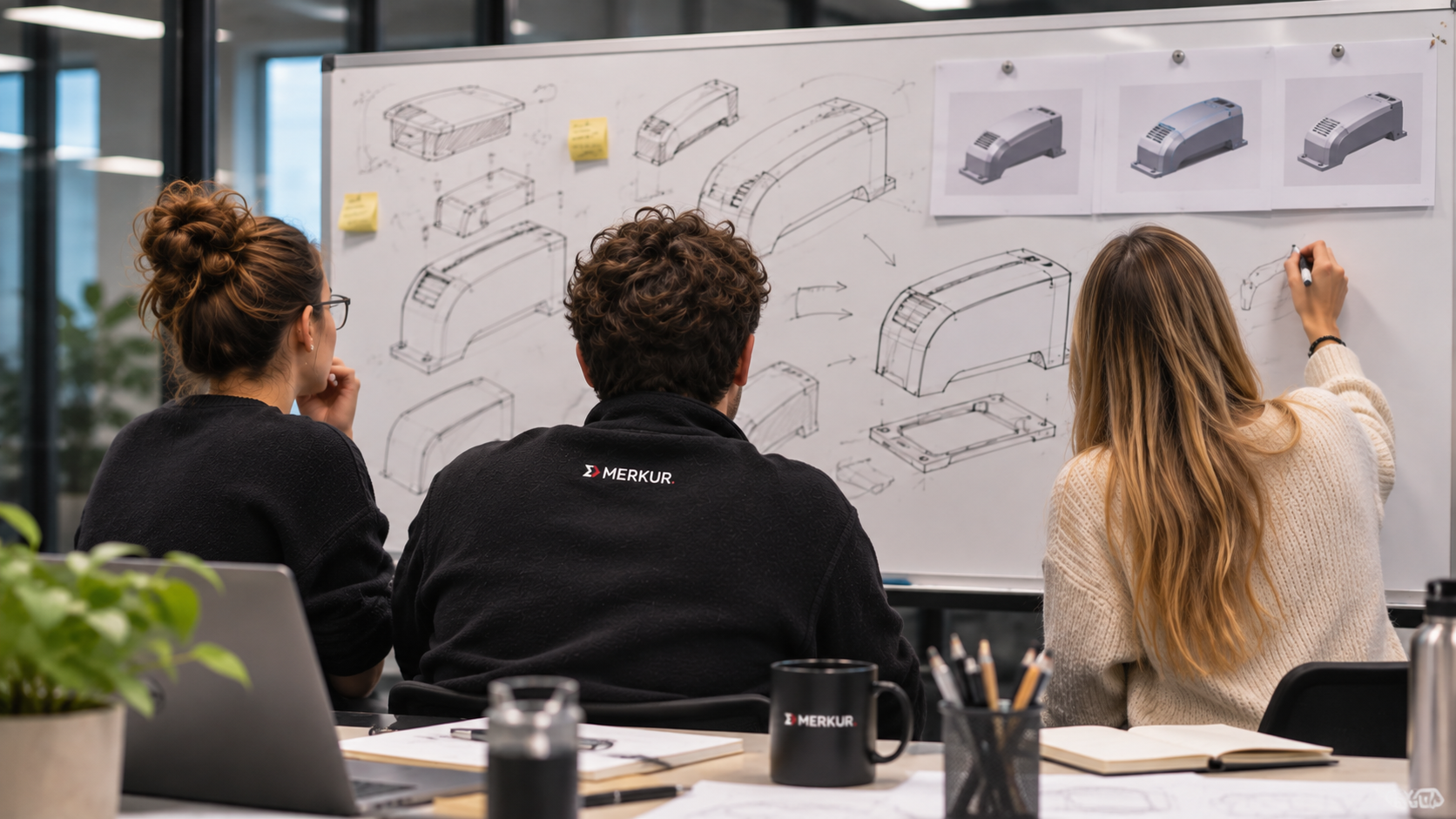
A concept study, or conceptual engineering, is one of the first phases of the product development process, between opportunity analysis and detailed design. Its goal is simple: turn a still-fuzzy need into a validated concept, ready for engineering.
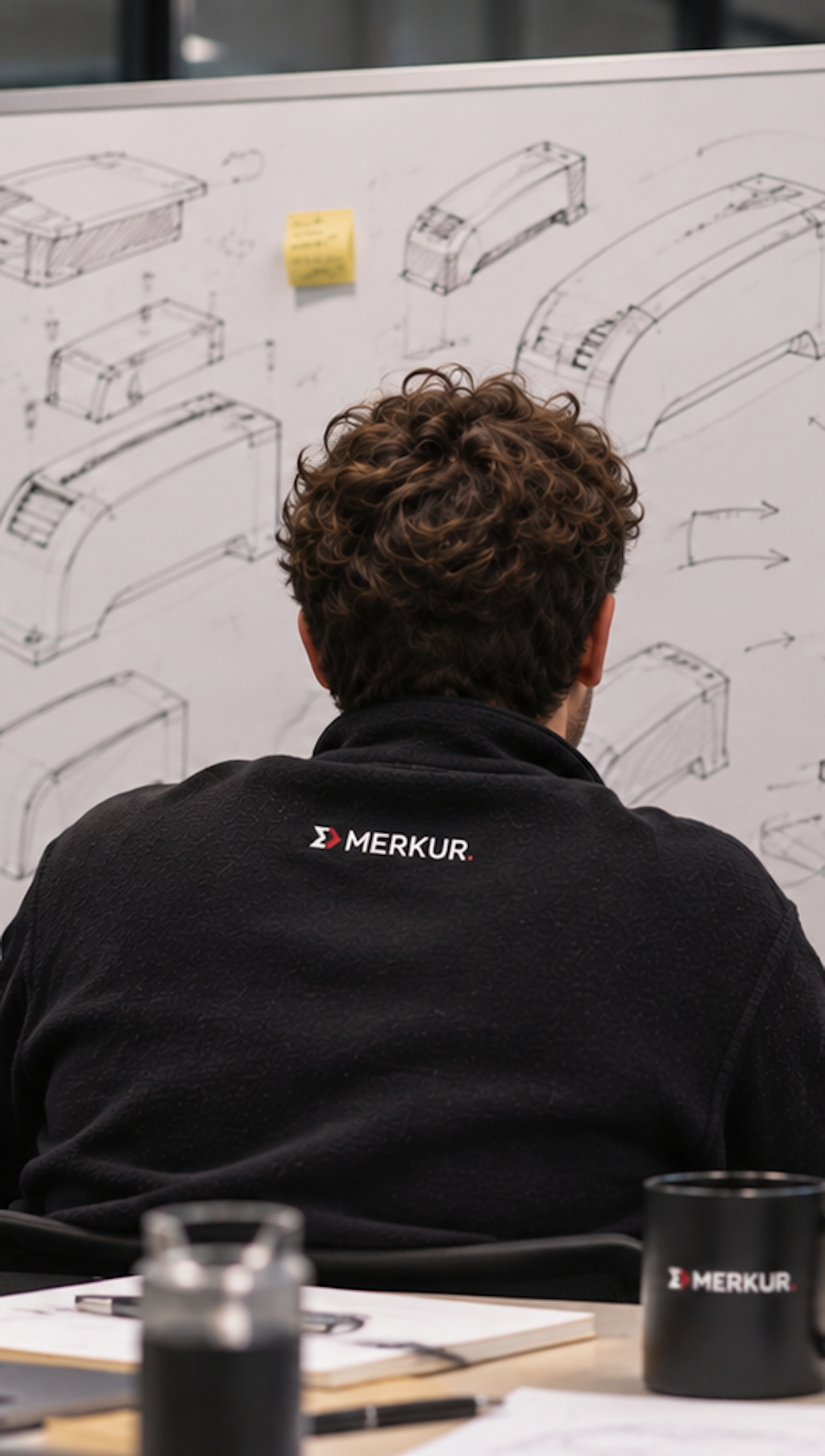
If we had to sum it up in three words: diverge, assess, converge. We open up the range of possible solutions, evaluate them against objective criteria, then narrow down to the clear choice.
At Merkur, the process has five steps, each delivering a usable outcome:
| Step | What we do | Main deliverable |
| 1. Needs definition | Voice of the customer, functional analysis, benchmarking, applicable standards | Initial functional specification |
| 2. Ideation | Multidisciplinary workshops, technology and patent watch | Concept portfolio |
| 3. Evaluation and screening | Feasibility, value and costs, risks per concept | Comparative report and recommendations |
| 4. Concept freeze | Consolidated review, formal decision | Selected concept package |
| 5. Preliminary design | Exploratory prototyping of uncertain assumptions | Roadmap to detailed engineering |
The process adapts to the scope of the need: streamlined for a single part or option, in-depth for a new product line.
You’re no longer betting; you’re deciding.
Six telltale signs
Certain situations show that the front-end phase deserves more attention. You may recognize yourself in one of them:
-
Your products are highly customized or configurable, and every new project starts almost from scratch.
-
Your engineering team has become a bottleneck: ongoing deliveries absorb all its capacity.
-
Rework with production is frequent: manufacturing issues are discovered after drawings are released.
-
A few key experts carry most of the decisions, and their availability sets the pace of projects.
-
You’re targeting a new product or market outside your usual expertise: diversification, dual use, electrification.
-
Your growth is rapid, without a strongly structured R&D function, and design decisions are made as you go.
The test: think back to your last project. Did the major changes come before or after the design freeze? If the answer is “after,” the front-end phase probably deserves a closer look.
Not just for complex products
Concept studies are often associated with new products or complete product lines. Yet they can also focus on a single part or option.
And the higher the production volume, the higher the stakes. A little less material, one less operation or a simpler assembly, and the savings are repeated on every unit produced. A “simple” part made by the thousands often justifies upfront thinking more than a complex product made in small batches.
What you get… and what you don’t
At the end of a concept study, you will have:
-
several concepts compared against criteria you defined yourself;
-
a preliminary cost estimate, before committing to detailed engineering;
-
identified technical risks;
-
a documented decision you can defend before your committee or your client.
It is not, however, a production-ready product, and there is no guarantee the original idea will be retained. The process even includes a deliberate “No Go” decision: redirecting a project early, based on facts, is also a valuable outcome. In other words, you’re no longer betting; you’re deciding.
When it’s probably not necessary
If your concept is imposed (by a standard or by a client who provides a complete design), or if the solution is proven and only needs to be executed, a full concept study is probably not necessary. The goal is not to add a step, but to secure the decisions that matter.
An outside perspective: an accelerator, not a loss of control
A team absorbed by day-to-day operations naturally develops blind spots. A neutral, multidisciplinary outside perspective, like Merkur’s, makes it possible to challenge certain assumptions, uncover those gaps and push the thinking further, especially when knowledge rests with a few key experts.
At Merkur, this perspective draws on more than 30 years of product and process development projects, and on a team covering mechanical, electrical, automation, simulation and manufacturing engineering. DFM and DFA principles are built in from the concept phase, for concepts that are not only innovative but also realistic given the demands of series production.
The approach remains resolutely collaborative: we work with your teams, integrate their hands-on knowledge and ensure knowledge transfer. Your intellectual property remains yours, and a non-disclosure agreement is signed before any work begins.
Where to start?
There’s no need to launch a full study to test the idea. A few hours of Merkur expertise with your team, on a part, an option or a real project, is enough to validate, stress-test and explore alternative concepts. You come away with an informed opinion, practical advice and actionable ideas.
Have a project in mind?
A few hours with our experts is enough to validate your concept or explore other options.